Housing cost overburden rate in Europe: structural divergence and cost pressure
This page tracks the housing cost overburden rate across EU and EFTA countries from 2010 to 2024. The indicator measures the percentage of the total population living in households where housing costs exceed 40 % of disposable income.
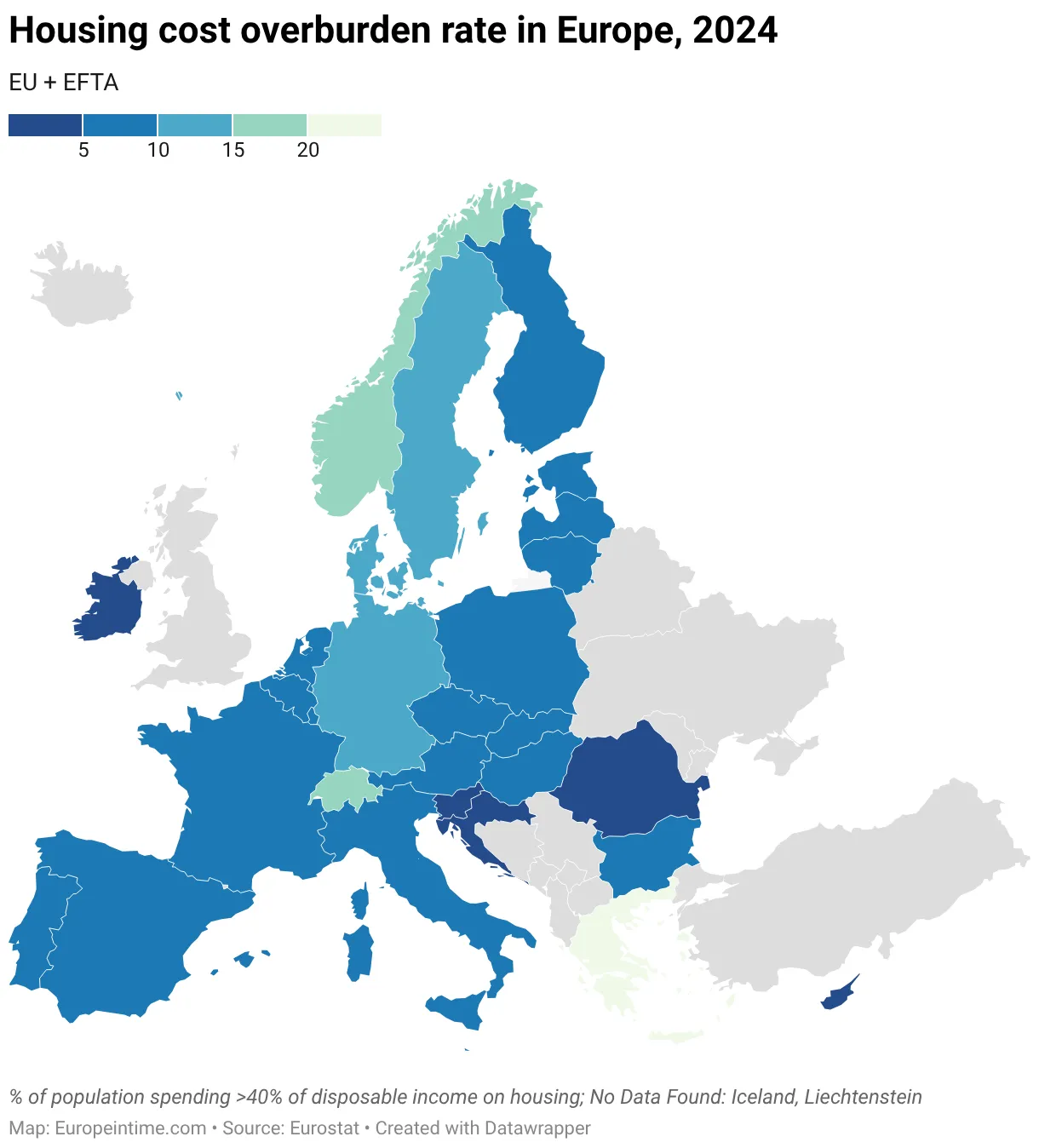
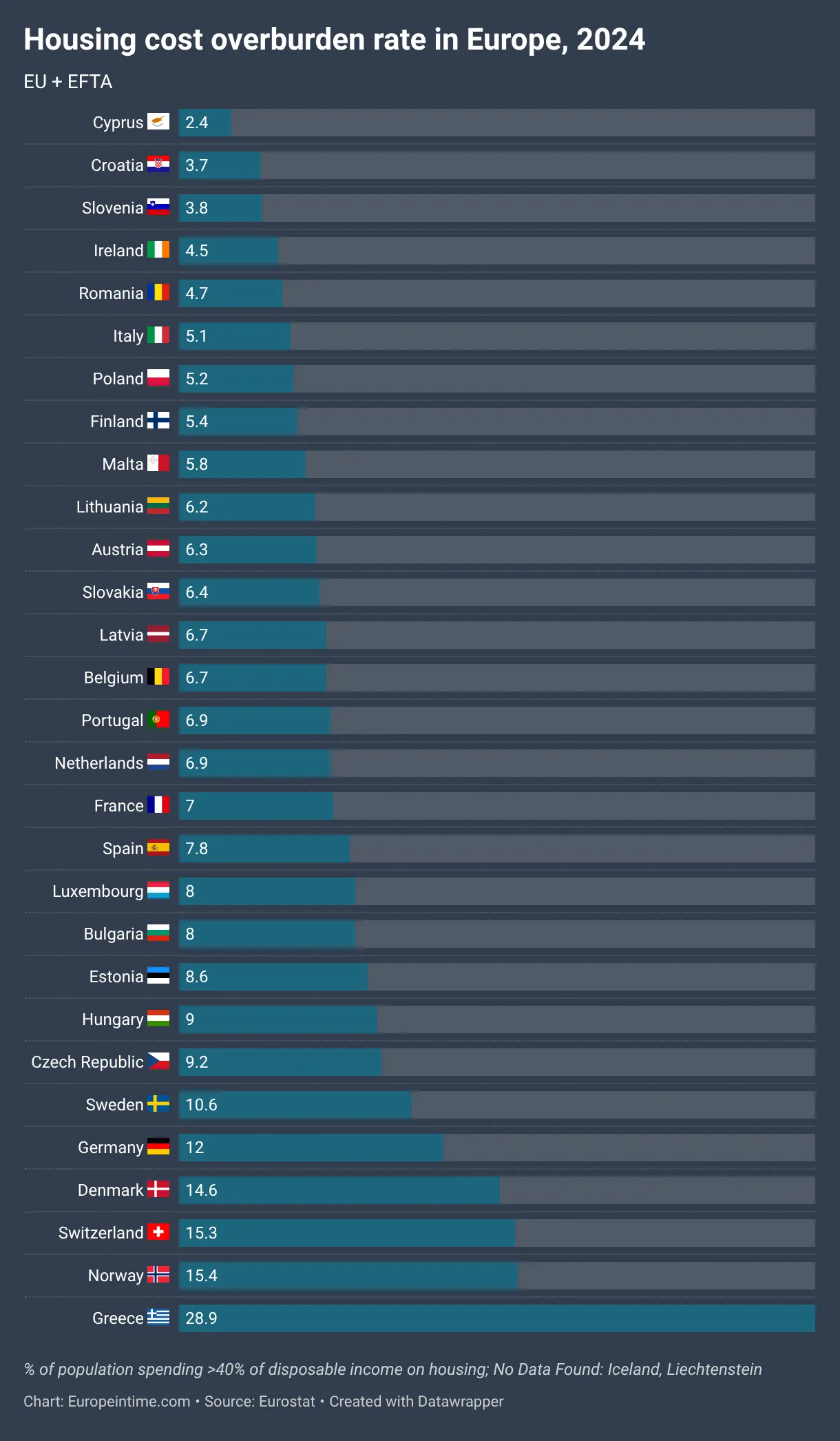
In 2024, housing affordability differs sharply across Europe. The highest housing cost overburden rates are recorded in Greece (28.9 %), Norway (15.4 %) and Switzerland (15.3 %). Greece stands out as a clear structural outlier: nearly three out of ten people live in households spending more than 40 % of disposable income on housing.
At the other end of the spectrum, the lowest levels in 2024 are observed in Cyprus (2.4 %), Croatia (3.7 %) and Slovenia (3.8 %). In these countries, excessive housing cost pressure affects only a small fraction of the population.
The gap between Greece (28.9 %) and Cyprus (2.4 %) exceeds 26.5 percentage points, illustrating deep structural differences in European housing systems.
To explore these dynamics, the page provides three complementary views: Current map, Current table and Time series.
Extended analysis
1) Structural divergence since 2010
Between 2010 and 2024, housing affordability trends have diverged markedly. While some countries experienced gradual improvement, others recorded persistent increases in housing cost pressure.
Greece illustrates a pronounced structural deterioration. The housing cost overburden rate rose from 18.1 % in 2010 to 28.9 % in 2024 (+10.8 p.p.). This increase occurred despite broader macroeconomic adjustments over the period.
2) High-income economies with rising burden
Elevated housing cost overburden is not confined to lower-income countries. In Norway, the rate increased from 9.1 % in 2010 to 15.4 % in 2024 (+6.3 p.p.), while Luxembourg rose from 4.7 % to 8.0 % (+3.3 p.p.).
These patterns suggest that high housing prices and rental markets can generate affordability pressure even in wealthy economies.
3) Countries with the strongest improvement
Romania reduced its housing cost overburden rate from 15.8 % in 2010 to 4.7 % in 2024 (−11.1 p.p.), representing one of the largest improvements in Europe.
Croatia declined from 14.1 % to 3.7 % (−10.4 p.p.), moving toward one of the lowest levels on the continent.
4) Structural vs cyclical housing stress
The time series reveals that in some countries, housing cost pressure fluctuates with economic cycles. In others, such as Greece, the burden has increased persistently, indicating deeper structural vulnerability in housing systems.
Understanding these long-term divergences is essential for interpreting future affordability risks in Europe.
Archive of maps and tables